Industrial energy / Technical guide
Industrial power generation: Options, efficiency and how to choose
Industrial power generation is electricity produced for a facility’s own use, at or near the site, instead of being bought only from the grid. The right system depends on the load, available fuel and natural resources, useful heat demand, reliability requirements, and the real cost of an outage.
THE SHORT VERSION
TL;DR
- Industrial power generation produces electricity—and often useful heat—at or near the facility that uses it.
- Combined heat and power can exceed 80 percent total system efficiency, compared with about 50 percent for typical separate heat and power.
- Gas turbines and combined-cycle systems suit large loads; engines, microturbines, and fuel cells serve smaller or modular loads.
- Wind, solar, geothermal, and battery storage are generally the lowest-emission options. Strong systems pair a low-cost primary source with dependable backup.
- Choose from the load profile, reliability needs, local resources, emissions targets, and lifetime cost—not from technology alone.
01 / DEFINITION
What industrial power generation actually means
The term covers more than a generator running a factory floor. At its broadest, it is an engineered power system serving a plant, hospital campus, data center, cold-storage operation, or other power-intensive facility.
The IEEE Technology Navigator describes industrial power systems as the electrical distribution and generation infrastructure that supplies, conditions, and manages power inside manufacturing plants, processing facilities, and large commercial buildings. That includes switchgear, transformers, protective relays, power-factor correction, harmonic mitigation, and on-site generation—from standby units to cogeneration plants.
Industrial power generation therefore asks two connected questions: where does the electricity come from, and how is it delivered and protected once it is inside the facility’s fence?
02 / POINT OF USE
On-site generation versus the grid
Central-station plants send power over long transmission lines. On-site generation sits at the point of use. The U.S. Department of Energy calls combined heat and power a type of distributed generation located at or near where the energy is consumed.
Most industrial sites still lean on the grid. The U.S. Energy Information Administration notes that most electricity used at industrial facilities comes from grid purchases, though many facilities add their own equipment for resilience and operational value.
The practical difference comes down to three things:
- Losses. Power made on site avoids transmission and distribution losses.
- Heat. A facility next to the generator can put waste heat to work. A distant plant cannot.
- Control. The operator decides how the system is configured, fueled, protected, and backed up.
03 / TECHNOLOGY OPTIONS
The main technologies, side by side
No single technology wins everywhere. Capacity, load shape, fuel availability, thermal demand, emissions requirements, and required response time all change the answer.
| Technology | Typical role | Electrical efficiency | Notes |
|---|---|---|---|
| Reciprocating engines | Small to mid-size prime power and CHP | 27–38% | Modular and responsive |
| Microturbines | Small CHP and modular loads | 15–32% | Compact packages |
| Fuel cells | Clean, quiet, steady loads | 40–57% | Strong electrical efficiency |
| Gas-fired steam turbines | Steam-heavy sites | 30–40% thermal | Rankine cycle |
| Combined-cycle gas turbines | Large primary and hybrid power | 55–60% thermal | High efficiency and scalable output |
The engine, microturbine, and fuel-cell figures come from the Department of Energy’s Industrial Applications for Micropower assessment. The source is from 1999, so the efficiency ranges remain useful for comparison while its historical equipment costs should not be treated as current quotes.
The steam and combined-cycle ranges come from the University of Texas at Arlington’s open textbook chapter on natural-gas generators. It identifies gas turbines and combined-cycle generators as strong candidates for large primary and hybrid applications because of their efficiency and scalability.
04 / USEFUL HEAT
Combined heat and power: More from every unit of fuel
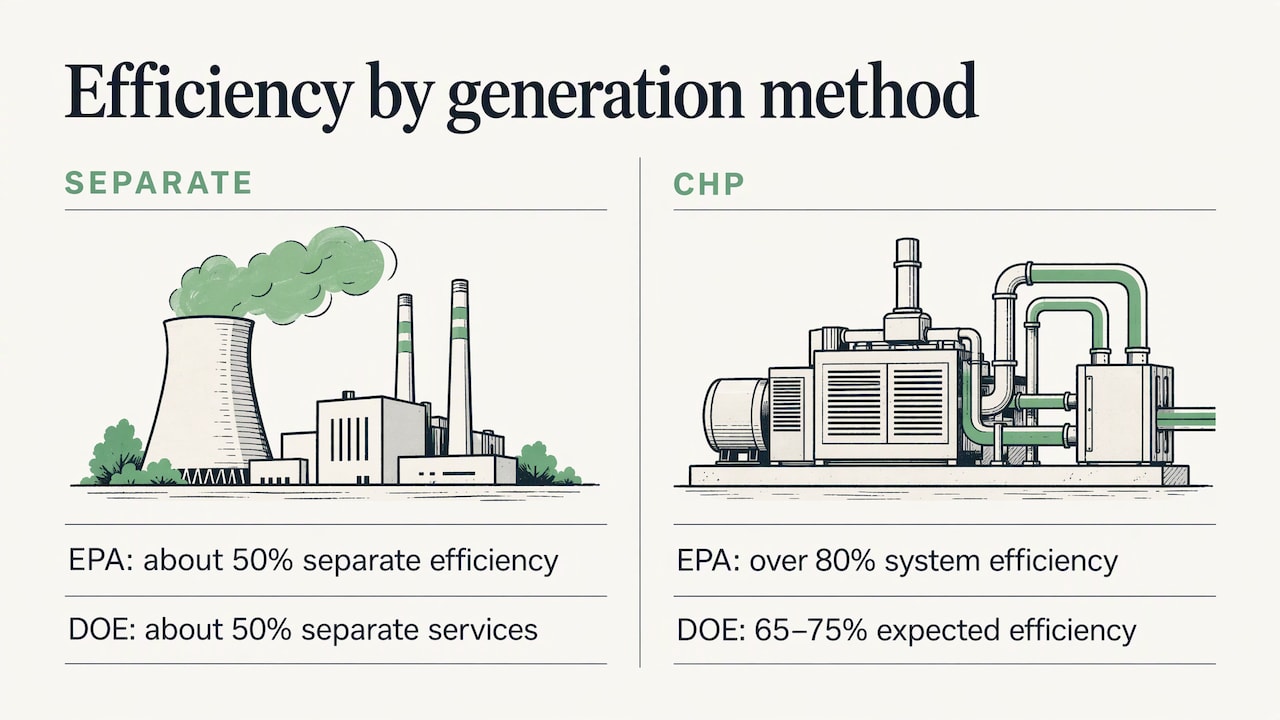
Conventional generation throws away a large share of its input as heat. The EPA’s Catalog of CHP Technologies says that in conventional separate generation, nearly two-thirds of energy is wasted as heat discharged to the atmosphere. CHP can reach total system efficiency above 80 percent, compared with about 50 percent for typical separate heat and power.
The Department of Energy gives a more conservative expected CHP efficiency of 65 to 75 percent. The real number depends on the equipment and how much recovered heat the facility can put to work.
CHP pays off most where there is steady, year-round demand for both power and heat or steam: food processing, chemicals, paper, hospitals, and campuses. If useful heat demand is intermittent, much of the efficiency advantage shrinks.
05 / CONTINUITY
Designing for reliability
For a continuous-process plant, cold-storage facility, hospital, or data center, generating power is only half the problem. The other half is keeping it on.
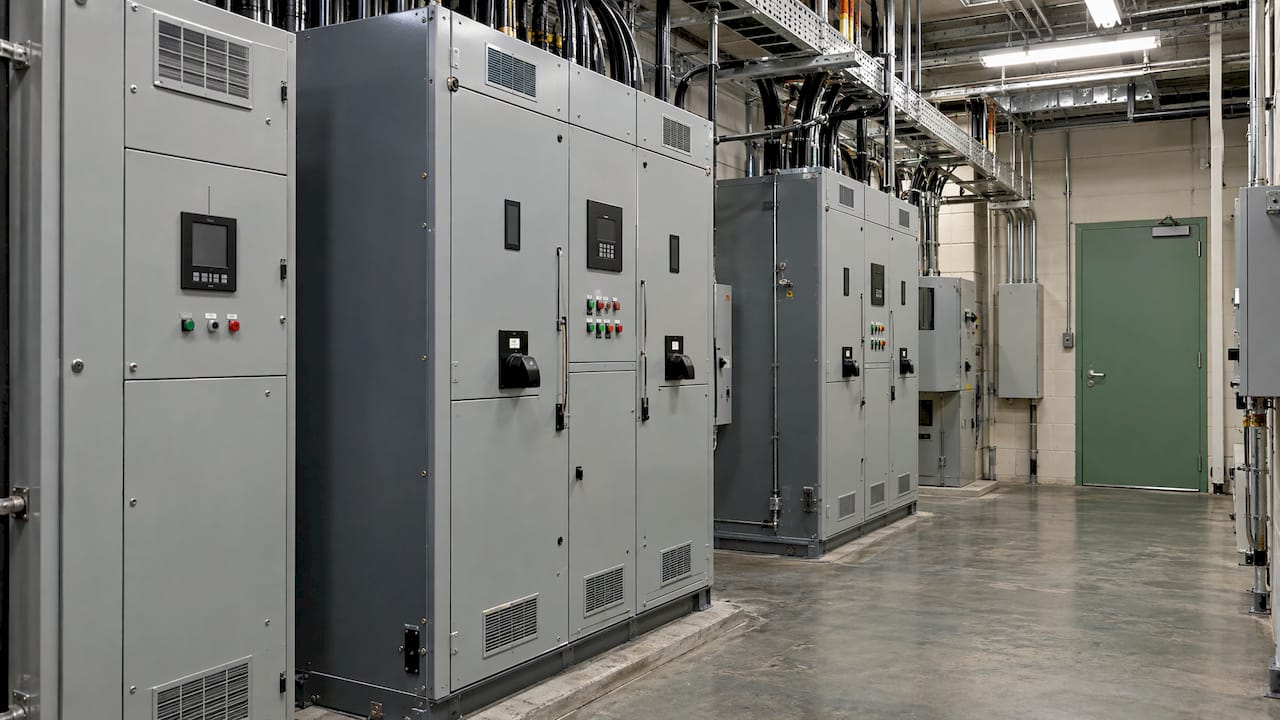
The IEEE Technology Navigator notes that critical production processes may receive duplicate feeds with automatic transfer switches to maintain continuity during a utility disturbance or equipment failure. Reliability-centered design puts a number on what an hour of downtime costs, then adds redundancy until the next increment costs more than the risk it removes.
Maintenance belongs in the calculation. The UK government’s CHP guide says engine and gas-turbine CHP units need inspection and maintenance at least once a year. If a facility cannot accept a planned shutdown, a second unit or source must carry the load while the first is serviced.
06 / LIFETIME VALUE
Emissions and cost: How the options compare
The UTA comparison of generation options finds wind, solar, geothermal, and battery energy storage generally among the lowest-emission solutions, while diesel produces the highest pollutant levels.
On unsubsidized energy cost, its analysis places wind and solar at the low end, followed by natural gas. But the most important conclusion for an industrial buyer is not a single winner. Strong strategies pair a primary source with low levelized energy cost with a dependable solution for backup and peak demand. The best mix changes with the resources, tariffs, and operating needs of each location.
Industrial power generation goes wrong when a facility picks a technology first and studies the site second. The load, land, water, heat, subsurface, and weather are different at every location, so a single catalog answer will usually be oversized, underused, or fragile.
Our approach starts from the site. We look at which geothermal, hydro, solar, and wind resources are actually present, then pair them into a system designed around the facility’s demand. Where heat matters, we plan the thermal and electrical infrastructure together.
The best power plant for your facility is the one designed around your site and your load.
— Dylan
07 / DECISION SEQUENCE
How to choose a system for your facility
Work through the criteria in order. Each decision narrows the field.
- Profile the load. Record peak demand, average demand, and hourly and seasonal swings. Flat 24/7 loads favor steady sources; spiky loads need fast capacity or storage.
- Put a price on downtime. Calculate what an interruption costs per hour and how much redundancy that exposure justifies.
- Map the heat demand. If the site needs steam, hot water, cooling, or process heat year-round, integrated thermal design can raise total efficiency.
- Inventory local resources. Assess sun, wind, flowing water, geothermal potential, fuel supply, land, and interconnection conditions.
- Set emissions and regulatory targets. Identify air permits, local rules, utility requirements, and corporate commitments early.
- Compare lifetime cost. Include fuel, planned maintenance, redundancy, interconnection, storage, and the cost of the backup tier.
- Plan for growth. Use a modular design that can add capacity without replacing the original system.
08 / APPLICATION FIT
Matching the system to your sector
Data centers
The load is high, flat, and intolerant of interruption. Prime power from firm sources, redundancy, and fast transfer matter more than headline efficiency. Heat recovery can add value where a nearby process or district system can use it.
Manufacturing
Many plants combine a large electrical load with continuous heat or steam demand—the textbook case for CHP or integrated renewable thermal design. Process continuity drives the redundancy plan.
Hospitals
Continuous power is non-negotiable, and hospitals use heat, hot water, and cooling year-round. That combination suits integrated electrical and thermal systems with duplicate supply paths.
Growing communities and developments
Demand grows in phases. Modular generation that scales with each phase avoids stranded capital and lets a development add capacity as it adds buildings.
09 / SITE-SPECIFIC INFRASTRUCTURE
Where Power Pasture™ fits
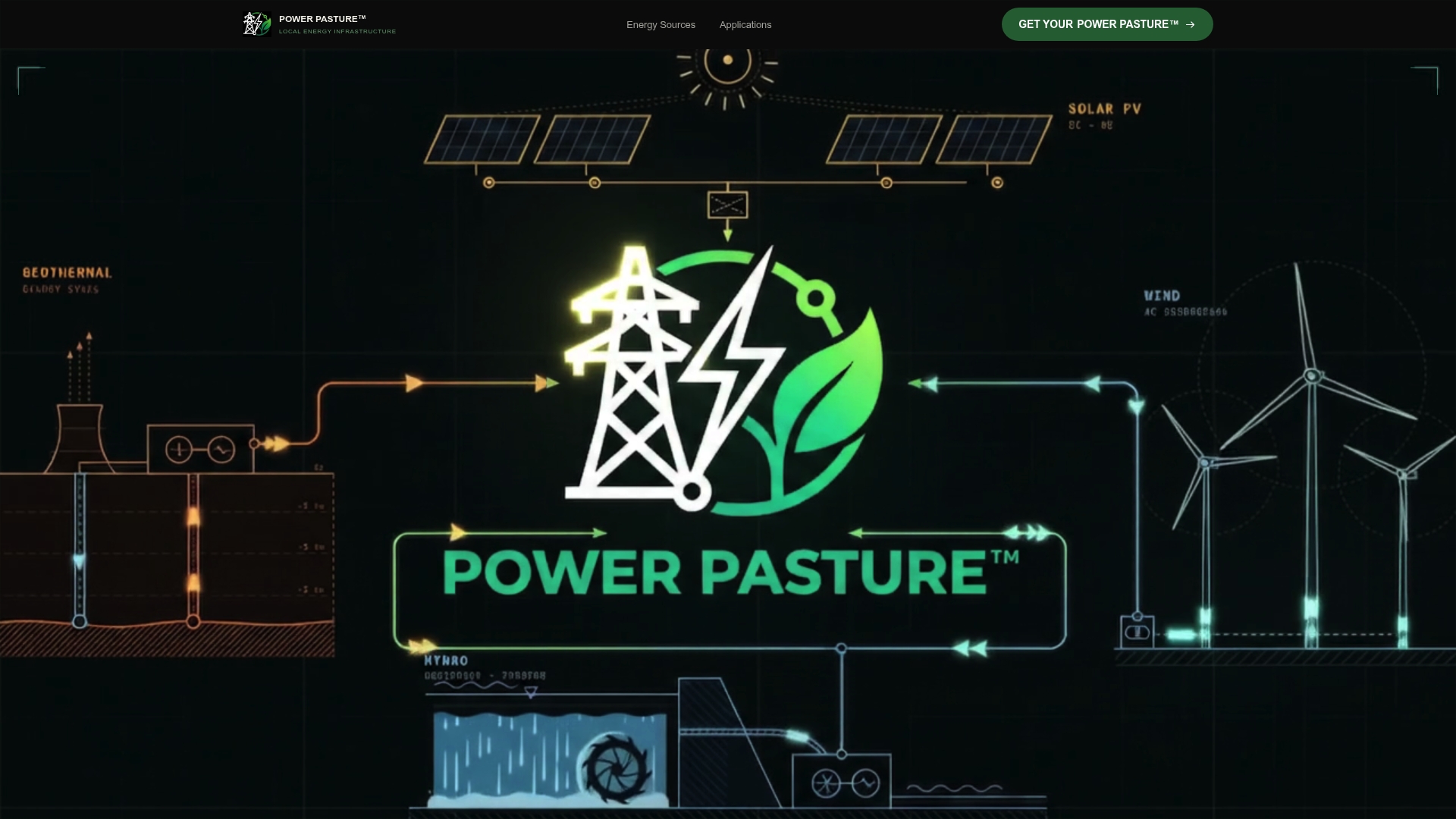
We design and implement custom renewable energy infrastructure for power-intensive users, including data centers, manufacturing facilities, hospitals, and commercial and residential developments. Our systems combine geothermal, hydro, solar, and wind according to local resource availability, with modular scaling, dense and dispatchable generation, and stable 24/7 operation as design goals.
Tell us about your load, location, heat demand, and reliability requirements. Project scope and pricing are set per site, so the work begins with the facility and the resources around it.
10 / COMMON QUESTIONS
FAQ
What is the difference between industrial and utility generation?
Utility plants are centrally located and deliver power over transmission and distribution networks. Industrial generation sits at or near the facility that uses the power, which can avoid network losses, recover useful heat, and support a site-specific reliability design.
Is combined heat and power the same as cogeneration?
Yes. Both terms describe the concurrent production of electricity or mechanical power and useful thermal energy from a single energy source. The approach works best where demand for both electricity and heat is steady.
Which industrial generation technology is most efficient?
It depends on the measure. Combined-cycle gas turbines reach about 55 to 60 percent thermal efficiency, while fuel cells reach 40 to 57 percent electrical efficiency in the cited DOE data. When useful heat is recovered, engines, microturbines, and fuel cells can reach roughly 80 to 85 percent overall efficiency.
Can renewable energy provide reliable industrial power?
Yes, when the resources are designed as a system. Firm sources such as geothermal and hydro can carry steady demand where available, while solar and wind add low-emission energy and storage or dispatchable capacity covers gaps.
How often does an on-site generator need maintenance?
The cited UK CHP guide says engine and gas-turbine CHP units need inspection and maintenance at least once a year. A facility that cannot accept the shutdown should include redundancy so another unit or source carries the load.
11 / REFERENCES
Sources
- Combined Heat and Power Basics, U.S. Department of Energy
- Combined Heat and Power: Frequently Asked Questions, U.S. EPA
- Catalog of CHP Technologies, U.S. EPA
- Industrial onsite generation increasingly relies on natural gas, U.S. EIA
- Industrial facilities get most of their electricity from the grid, U.S. EIA
- Combined heat and power technology fills an important energy niche, U.S. EIA
- Industrial power systems, IEEE Technology Navigator
- Natural Gas Generators, Powering Large Loads, UTA Pressbooks
- Comparative Analysis, Powering Large Loads, UTA Pressbooks
- Industrial Applications for Micropower: A Market Assessment, U.S. DOE
- CHP Technologies guide, UK Government
- On-Site Power Generation, Electrical Generating Systems Association